Customer storyMacquarie University
A day lost for every missing detail: how a molecular biologist keeps her methods on the record
Fozia Masood's fruit fly experiments ran for a year before she had data to write up. Every detail she hadn't recorded, from a buffer volume to an instrument model, cost her a day of thesis writing. With Bower, those details are captured at the bench as they happen and kept in one organized place.
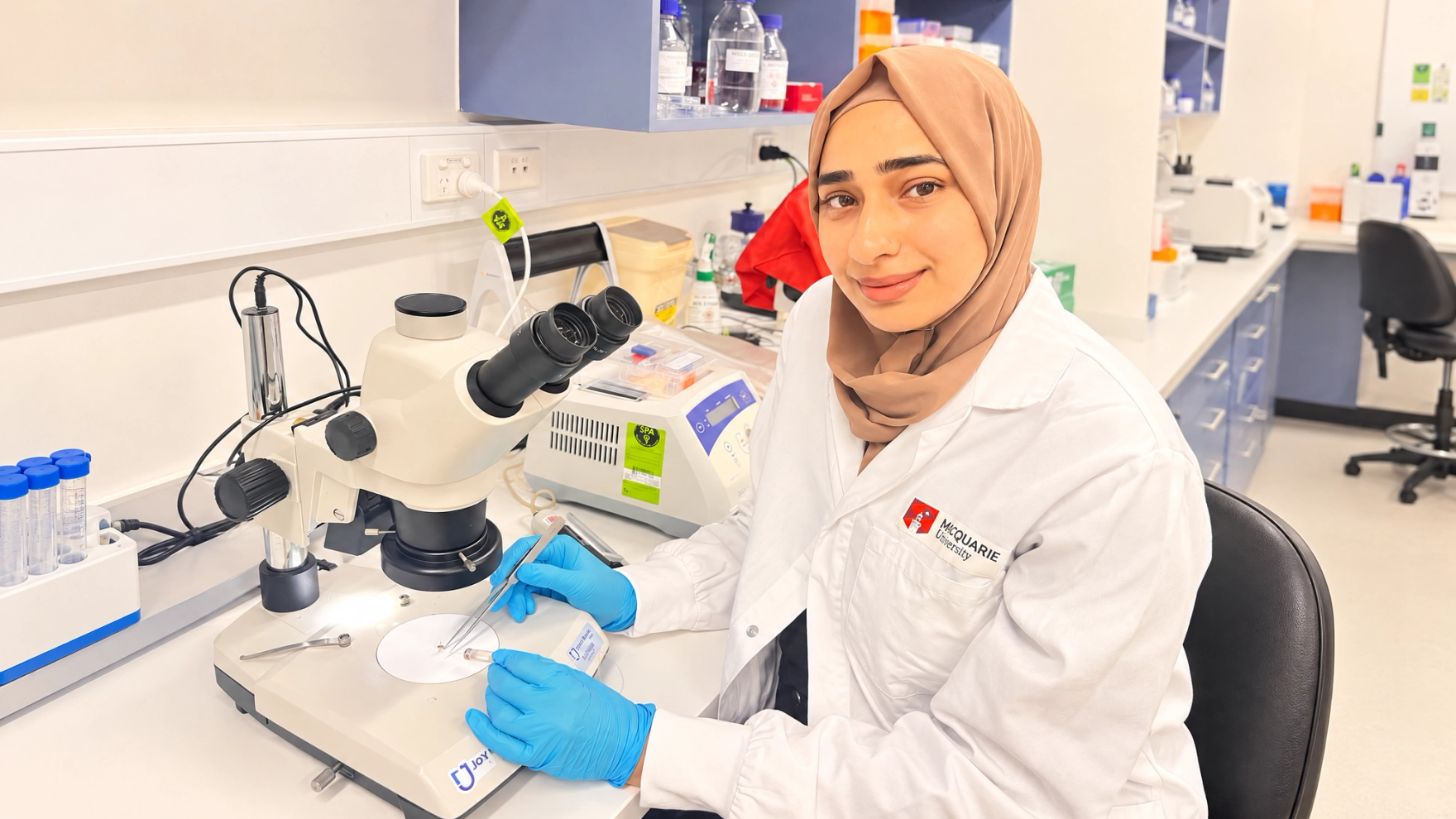
- Researcher
- Fozia Masood
- Field
- Applied BioSciences
- Organization
- Macquarie University
“If I've missed something, writing definitely has to stop. It's one day for each thing.”
At a glance
Details captured the day they happen
Every changed volume, buffer and instrument model is captured at the bench, into one organized record.
Methods written from the record memory → record
Writing up means searching one record, instead of stopping for a day to dig through old notes.
Know-how that stays in the lab
The techniques that never reach a methods section are captured while she works, ready for whoever picks up her work next.
The situation
A year of experiments before the first line of the thesis
Fozia Masood is a PhD candidate in Applied BioSciences at Macquarie University, working with fruit flies. She dissected them under a microscope, extracted DNA, RNA and protein from hundreds of tissue samples of different sizes collected at different time points, and sent them for sequencing. The data only arrives at the very end, so she started writing her thesis a year after the experiments.
At the bench, her notes went on tissue paper or whatever was nearest. She expected to remember the rest.
The challenges
Every sample needed its own volume
The RNA extraction kit's standard protocol didn't fit every sample, so she adjusted the volume and buffer for each one. A year later, in the methods chapter, she knew she had changed something but not what. Each missing detail cost her a day: stop writing, dig out the notes, recalculate.
The instrument was replaced before she wrote it up
Her flies were kept at a constant temperature in a water bath, and she never noted its model number. When she went back to check, it had broken and been replaced, and tracking down the original model took a lot of chasing.
Her technique leaves when she does
Pre-chilling metal tube holders to -80 °C so bead crushing doesn't heat and degrade the RNA. An ice pack under the slide during microdissection. Fozia developed these by trial and error, and none of them made it into her thesis or published papers.
What changed
Fozia makes the calls at the bench. Bower keeps the record.
Fozia decides the volume for each sample and how to keep tissue cold under the microscope. Bower captures each decision as she makes it and keeps every note organized for the write-up. She tested it while writing her thesis, against the experiments she had just finished.
01Capture
Recorded the moment it happens
A changed volume or an instrument model is captured at the bench by voice, photo or text, so it's on the record when the writing starts.
02Organize
Every note in one place
Notes, photos and protocol changes sit together in one organized record, searchable a year later and safe from lab moves.
03Handover
Know-how the next student can use
The techniques she developed by trial and error are captured as she works, so the next person in the lab starts where she finished.
“Bower is a really helpful tool for daily experimental work. It’s quick and easy to record, and everything is organized in one place.”